Category: Uncategorized

  • Embroidery vs. Patches vs. Print: Decorating Youth Baseball Hats

    Embroidery vs. Patches vs. Print: Decorating Youth Baseball Hats

    Two teams can order the exact same cap and end up with completely different-looking hats, because the decoration method matters as much as the blank underneath it. A stitched crest reads as classic and permanent; a full-color transfer reads as modern and sharp; a raised puff logo reads as loud and athletic. For a youth baseball team, picking the right method is mostly about three things: how detailed the logo is, how many colors it uses, and whether the cap front is structured or soft. Get those to line up and the hat looks like it cost more than it did.

    Here is how the common methods actually differ, with the tradeoffs that matter when you are buying for a roster rather than a single hat.
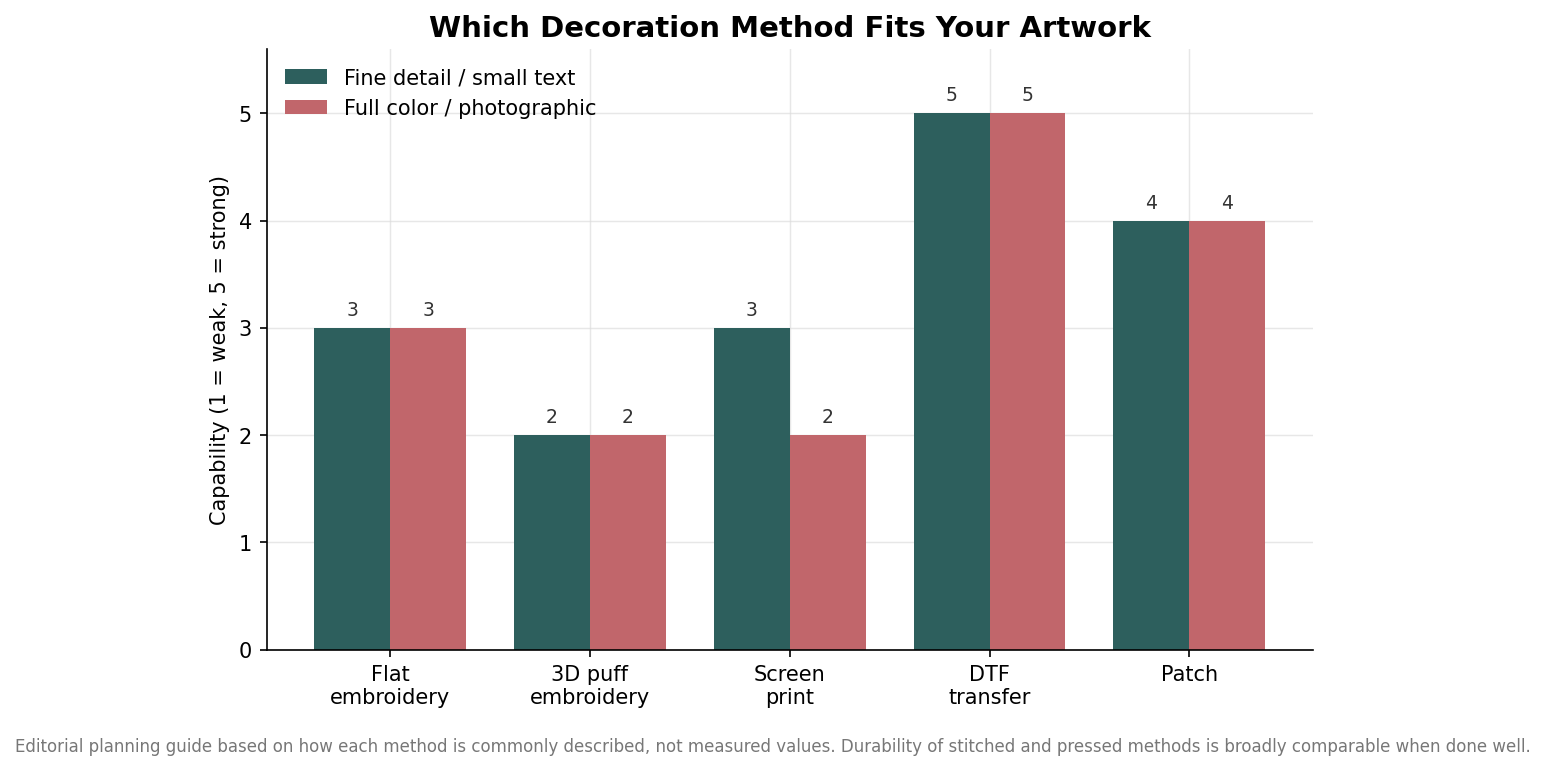
    Grouped bar chart comparing hat decoration methods on fine detail and full-color capability
    An editorial planning guide to which decoration method suits detailed or full-color artwork.

    Flat embroidery: the team-hat default

    Flat embroidery stitches thread directly into the cap panel, and it is the default for a reason. Because the color lives in the thread rather than sitting on top of the fabric, it does not crack, peel, or fade the way a surface print eventually can, which is exactly what you want on a hat that gets sweated in and tossed in a bag all season. It carries a clean team monogram or a simple mascot well. Where it struggles is fine detail: thin lines, gradients, and small lettering below roughly a quarter inch tend to fill in or lose legibility once they are converted into stitches. If your logo has tiny text or delicate linework, plan to simplify it for thread or choose a method built for detail.

    3D puff embroidery: bold, raised, and simple

    Puff embroidery lays a thin foam under the stitching so the design stands up off the crown. It gives a bold, varsity look that photographs well on a structured front, which is why it is so common on trucker and fitted caps. The catch is that puff is even less forgiving of detail than flat embroidery. It shines on thick block letters, a single initial, or a chunky logo shape, and it fights you on anything with small elements or more than two or three colors. Think of it as a way to make a simple design louder, not a way to reproduce a complicated one.

    Screen print and DTF transfers

    Surface methods put ink or a printed film onto the cap instead of stitching into it. Screen printing is economical once you are ordering in volume because the setup cost spreads across the run, but it wants a flat front panel, tops out around a four-inch design area, and works best at two to three colors; each added color raises setup cost. It also dislikes the center seam on a standard six-panel cap, so it pairs better with flat-front or five-panel styles. DTF (direct-to-film) transfers solve the color problem outright: they reproduce unlimited colors and photographic detail with no per-color setup and no real minimum, which makes them ideal for a small team order with a complex, multicolor logo. The tradeoff is that a transfer sits on the surface and can wear at seam lines over time, so it is a better fit for a one-season team hat than a decade-long uniform piece.

    Patches: woven, rubber, and leather

    A patch decorates a separate piece and then bonds it to the cap, usually by heat press or stitching. This is how you get texture the base cap cannot: a woven patch captures finer detail and small text better than direct embroidery, a rubber or PVC patch gives a modern raised matte look, and a leather patch reads premium on a trucker or dad cap. Patches also let you keep one consistent logo across several different hat styles, since the decorated element is identical regardless of what it is pressed onto. Pricing generally sits in the same premium range as embroidery. The main limitation is flexibility: the patch shape and size are set before it touches the hat, so it is less suited to wrapping a design around the crown.

    Matching the method to the cap and the roster

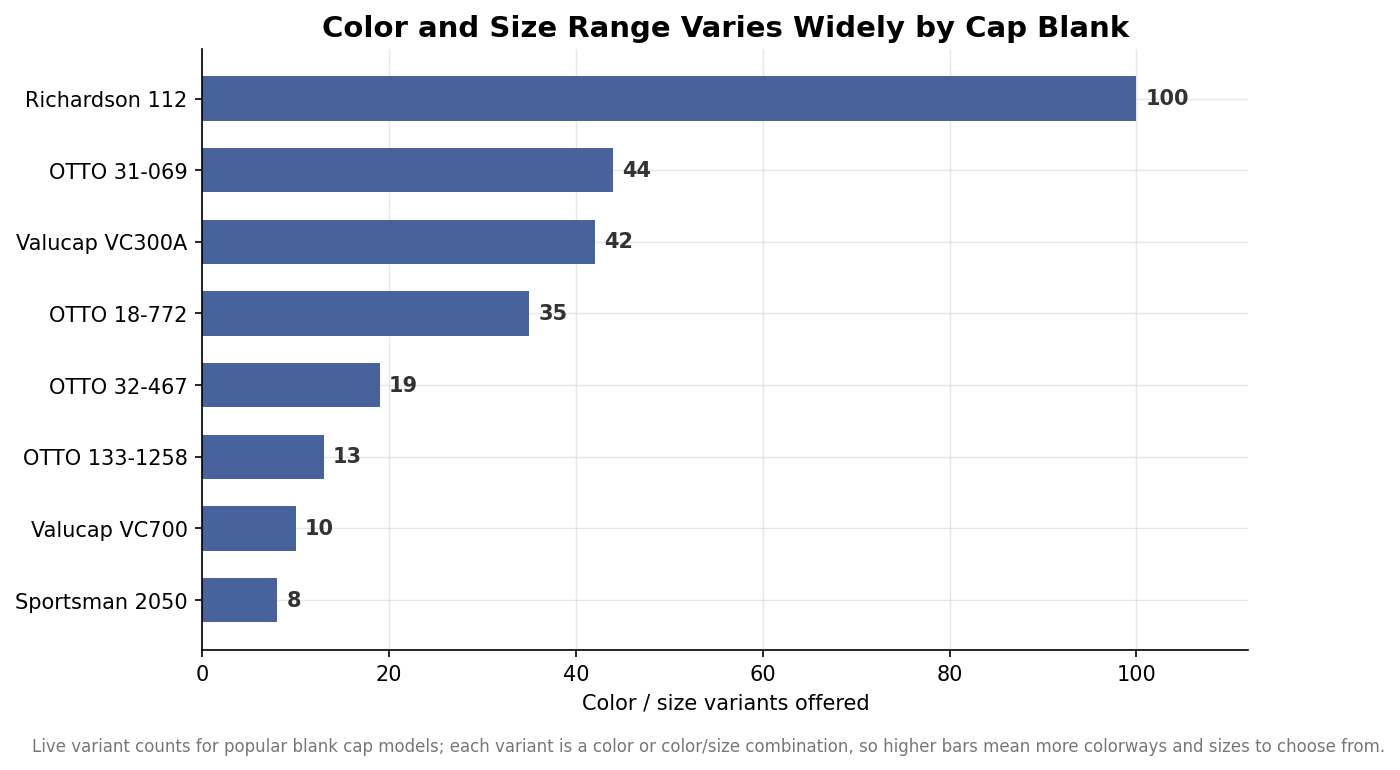
    The decoration only looks as good as the blank it sits on, so choose them together. The cap models offered here span structured and soft options, from the trucker-style Richardson 112 to several OTTO five- and six-panel profiles, plus Valucap and Sportsman styles, in size ranges from youth-friendly one-size options up through XS to 4XL, in team colorways like black, navy, royal, kelly, maroon, charcoal, khaki, and grey. That range matters because it determines your options: a structured trucker front is the natural home for 3D puff or a rubber patch, while a flat-front or five-panel cap opens up clean screen printing, and any of them take flat embroidery well.

    The chart above shows how much the color and size selection varies between blanks, which is worth checking before you fall in love with a specific hat, especially if your team colors are unusual or you need a wide spread of youth and adult sizes. As a rule of thumb for a youth team: a simple one or two-color team mark goes on almost anything with flat embroidery and lasts; a bold single logo pops in puff on a structured cap; a detailed, multicolor, or photographic design belongs on a DTF transfer or a woven patch. Decide the logo’s complexity first, let that pick the method, and let the method point you at the right cap, rather than the other way around.
  • Youth Baseball Hat Sizing: How to Measure and Order a Team That Actually Fits

    Youth Baseball Hat Sizing: How to Measure and Order a Team That Actually Fits

    A youth baseball cap has one job before it ever carries a logo: it has to fit a child’s head through a season of growth, sweat, and being crushed into the bottom of a bat bag. Fit is the first specification you lock down, not the last. Get it right and the embroidery sits square over the brow and the cap stays put through a headfirst slide into second. Get it wrong and you are reordering half your sizes by July. This walkthrough covers how to measure, how to translate that number into the right size, and the handful of construction and decoration choices that decide whether a custom team order fits the whole roster.

    Measure the head, not the birthday

    Age is a proxy, and a poor one. Two nine-year-olds can sit a full inch apart in head circumference, and an inch is the difference between a cap that grips and one that slides down over the eyes on a ground ball. So measure. Wrap a soft tailor’s tape (or a length of string you then hold against a ruler) around the largest part of the head, about one finger-width above the eyebrows and around the widest point above the ears. Keep it snug rather than tight, and record the number in inches or centimeters. For a team, collect every player’s measurement on one sheet before you order anything. It takes ten minutes at the end of a practice and it is the single best insurance against a reorder.

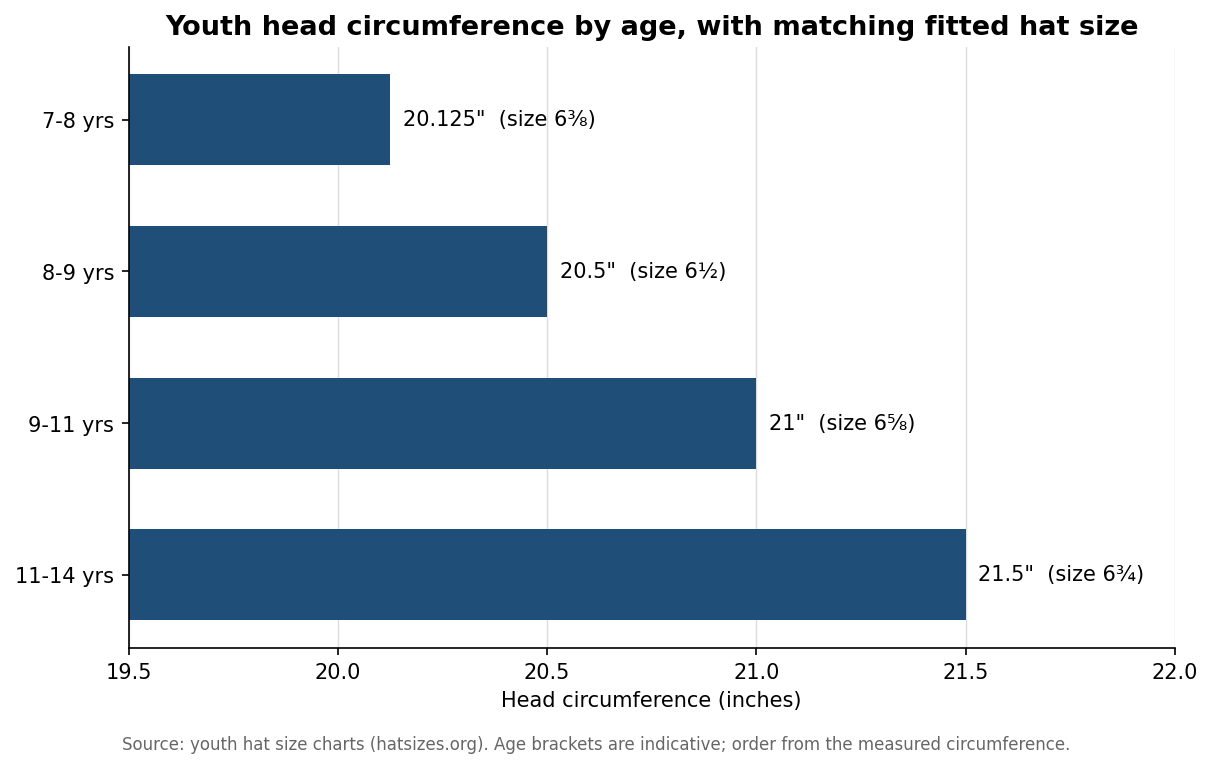
    Horizontal bar chart of youth head circumference in inches by age band with matching fitted hat sizes
    Youth head circumference by age, mapped to fitted hat sizes.

    As a reference point, youth head circumference generally runs from about 20⅛ inches (51 cm) around ages seven to eight up to roughly 21½ inches (54.6 cm) by ages eleven to fourteen, which maps to fitted sizes of about 6⅛ through 6¾. Treat the age brackets as indicative only. The measured circumference is the number you actually order from, and where a child falls between two sizes you round up.

    Match the number to a size band

    Once you have circumferences in hand, group them against the sizing system your chosen cap actually uses, because the systems are not interchangeable. Fitted caps use numbered sizes (6⅛, 6½, and so on) and fit exactly one circumference with no adjustment. Stretch-fit caps use banded sizes such as youth, S/M, and L/XL, where an elastic sweatband flexes across a range. Adjustable caps — snapback, hook-and-loop, or elastic — collapse the whole question into a single one-size cap that spans roughly 56 to 59 cm on the adult version and less on youth cuts.

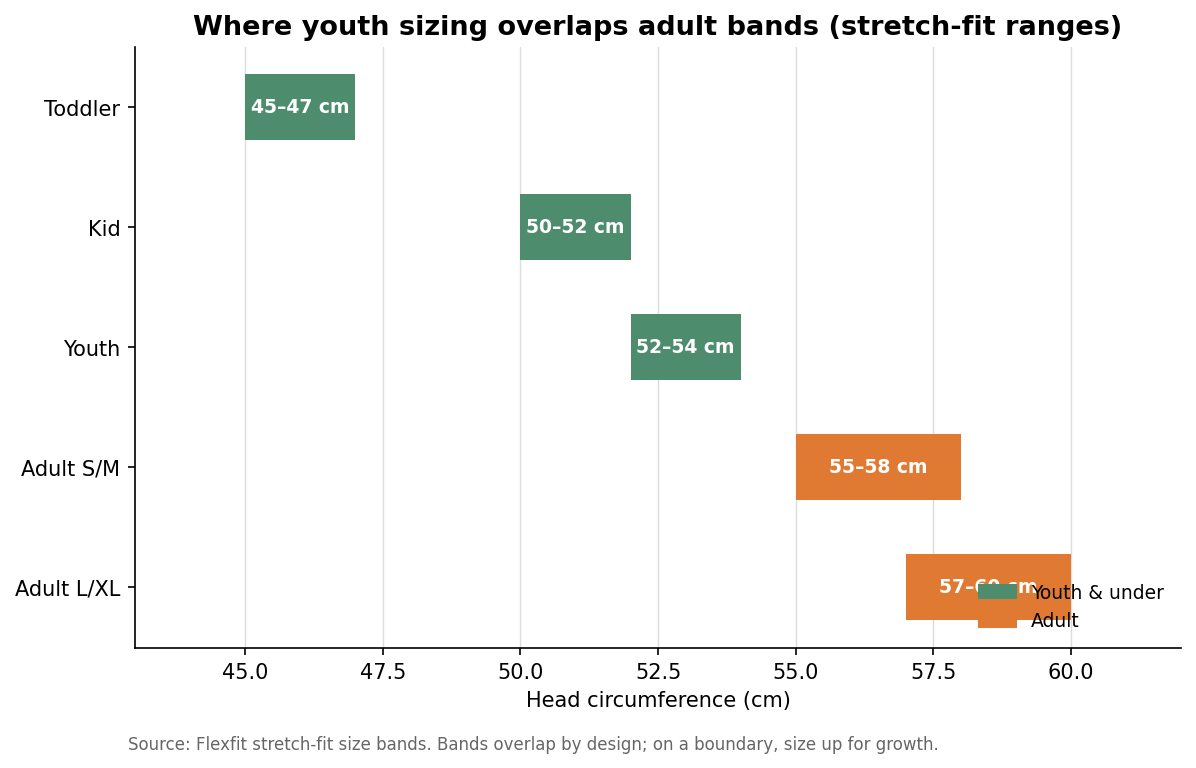
    Range chart showing how youth head-size bands overlap adult stretch-fit bands in centimeters
    Youth and adult stretch-fit size bands overlap, so on a boundary you size up.

    The bands overlap on purpose, which is why a child measuring 54 cm could reasonably wear a youth stretch cap or a small adult one. That overlap is your friend on a mixed-age roster: choosing an adjustable or stretch style lets you cover eight or ten different head sizes with two or three ordered sizes instead of a separate cap for every player. When a measurement lands right on a boundary, size up. Kids grow into a cap far more gracefully than they shrink into one, and a season is long enough that most of them will.

    Closure decides how much fit error you can absorb

    The closure is really a tolerance decision. A fitted cap has zero tolerance, so it demands an accurate measurement per player and leaves no room for a growth spurt. A snapback or hook-and-loop strap gives you a couple of inches of play, which forgives both measurement error and mid-season growth. Elastic stretch-fit sits in between, hugging a band without any hardware for younger kids who fidget with straps. For a youth team you are usually trading a perfect individual fit against the practicality of stocking fewer sizes, and adjustable styles almost always win that trade below the high-school level.

    Crown structure and panel count

    Structured crowns use a stiffened buckram backing behind the front panels, so the cap holds a tall, rounded shape and presents a flat, firm surface that embroidery sits on cleanly. Unstructured crowns — the softer, lower “dad cap” profile — slouch to the head and tend to be more comfortable for younger children, at the cost of a slightly less crisp logo area. Most baseball caps are six-panel with a center seam; a five-panel puts a single seamless panel across the front, which gives a larger uninterrupted space for a big logo. Profile height (low, mid, high) and a mesh trucker back are the other levers: mesh backs breathe well for summer ball, while a mid-profile structured six-panel is the safe default for a team look.

    Specifying the custom order

    Decoration comes after fit is settled. Flat embroidery is the most durable choice on cotton twill and reads well down to fairly small lettering; 3D puff embroidery lifts bold block letters off the crown for a varsity look; screen print, heat transfer, and woven or leather patches are alternatives worth pricing for larger or highly detailed art. Turning a logo into stitches (digitizing) is a one-time setup step, and the resulting stitch count is the main driver of both unit cost and production time. Minimum order quantities vary widely across the industry: some shops decorate a single cap, while bulk custom pricing commonly starts somewhere around 6 to 24 pieces. Turnaround for bulk embroidered caps is often in the range of one to three weeks after you approve the artwork, with rush options where available — treat those as typical rather than guaranteed and confirm the specific date in writing.

    Two habits save the most grief. Ask for a digital proof or, better, a physical pre-production sample so you can check thread colors against the actual crown color before the full run stitches out. And order one or two spares in each size band for the inevitable lost or destroyed cap. Fit first, decoration second, and a spare in the bag — that is how a youth order still fits and still looks like a team in the last week of the season.

  • Snapback, Fitted or Adjustable: Choosing for Kids

    Call or Text us: (929) 605-4397
    Specs

    Snapback, Fitted or Adjustable: Choosing for Kids

    Three closures, three trade-offs

    Three closures cover every youth team order, and each one trades convenience against look. Pick by how your team is run, not by the catalogue photo.

    Adjustable: the league workhorse

    A strap and buckle covers ages five to fourteen in one SKU. No sizing sessions, no exchanges, the lowest price per hat. If you are outfitting a division rather than a team, this is the answer and everyone knows it.

    Snapback: the look kids want

    Structurally it is an adjustable with a flat brim and attitude. The snap still covers the roster in one size, but the silhouette is the one older players wear, which matters enormously to a ten-year-old. It costs a little more than the twill cap and gets worn a lot more willingly.

    Fitted: the uniform statement

    No strap, no snap, the genuine pro look — and a size run to manage. Fitted programs suit academies and select clubs where the uniform is part of the identity and someone owns the kit logistics.

    The honest recommendation

    League order: adjustable. Club that wants swagger: snapback. Academy with a kit manager: fitted. Send the roster and we will mock up your logo on all three — free, within 24 hours, minimum order 12 hats.

    Create your custom youth baseball hats now.

    Send your logo, quantity and date — you’ll get a free mockup and quote within one business day.

    Get a Quote
    GET A QUOTE
  • Why the Hat Is the Team’s Real Identity

    Call or Text us: (929) 605-4397
    Team culture

    Why the Hat Is the Team’s Real Identity

    The uniform that leaves the field

    Jerseys come off in the parking lot. The hat stays on through the pizza stop, the school day and the whole summer — it is the identity that travels, and for most kids it is the first piece of team gear they genuinely love.

    Belonging you can hand out

    Youth sport runs on belonging. The day the hats arrive is the day the roster becomes a team — every coach has watched it happen. A well-made hat with a real embroidered crest tells a kid the team is serious, and that they are part of it.

    The parents are watching too

    Parents judge a program by its details, and headwear is the most visible detail there is. A league whose teams all wear matched, properly embroidered hats looks organised before a single pitch is thrown — and sells more registration next season because of it.

    Make it worth keeping

    The hats kids keep for years share the same traits: true youth fit, stitched logos, colours that match the jersey. Cut corners on any of those and the hat dies in a drawer by August.

    Start with the logo you have

    A phone photo of last season’s hat is enough — our designers redraw it into a clean embroidery file at no charge. Free mockup in 24 hours, minimum order 12 hats, production in 2 weeks.

    Create your custom youth baseball hats now.

    Send your logo, quantity and date — you’ll get a free mockup and quote within one business day.

    Get a Quote
    GET A QUOTE
  • Custom Youth Baseball Hats: A Buyer’s Guide

    Call or Text us: (929) 605-4397
    Buyer’s guide

    Custom Youth Baseball Hats: A Buyer’s Guide

    It is a logistics problem first

    Ordering hats for a youth team is a logistics problem disguised as a design problem. The design takes an afternoon; handing forty hats to forty kids whose heads you never measured is the part that goes wrong.

    Closure decides your logistics

    Adjustable straps and snapbacks mean one size per team and zero fitting sessions — that is why leagues and schools default to them. Fitted caps look the most professional and stay put best, but they need a size run, which only makes sense for clubs that manage uniforms properly.

    Youth sizing is not shrunken adult sizing

    A youth hat is cut on a smaller crown with a shorter brim, not just a tighter band. An adult hat cinched down swallows a nine-year-old’s ears. Order true youth cuts, and add a few adult sizes of the same hat for coaches and parents.

    Embroidery is the only durable option

    Kids’ hats live in gear bags, on dugout floors and in the rain. Stitching goes through the fabric and lasts the life of the hat; anything printed on the crown cracks and peels within a season. Raised 3D embroidery on the front is the standard for a reason.

    What to expect when you order

    Send your logo and your roster count. You will get a free mockup within 24 hours, unlimited free revisions, and you pay nothing until you approve it. Minimum order is 12 hats and production runs 2 weeks, with faster turnaround available on express shipping.

    Create your custom youth baseball hats now.

    Send your logo, quantity and date — you’ll get a free mockup and quote within one business day.

    Get a Quote
    GET A QUOTE